Microsoft 365 is one of the most widely used enterprise email solutions, thanks in part to the robust security measures built into Microsoft Purview Message Encryption and the Azure Information Protection (AIP) suite. These tools ensure that e-mail communications are encrypted and accessible only to authorized recipients.
Yet a key challenge remains: the secure transfer of large files. By default, Microsoft does not provide a solution to securely transfer large amounts of data without relying on external storage services. This is where mSafe plays a crucial role.
Challenges in secure data transfer
Traditional methods of file transfer via e-mail are limited:
- Attachment limit – Microsoft Exchange and Outlook have strict limits on attachment sizes, often around 25 MB.
- Cloud storage as an alternative – Microsoft OneDrive or SharePoint can be used to share larger files, but this requires additional operations such as setting up access rights and managing links.
- Compliance and logging – Many companies have strict requirements for audit trails and compliance (e.g. GDPR, ISO 27001), which is difficult to achieve with standard email sharing.
How mSafe solves this
mSafe is designed to address these shortcomings by providing a SaaS-based encryption and transfer solution that integrates deeply with Microsoft 365 and Outlook.
1. Direct Outlook integration without email server changes
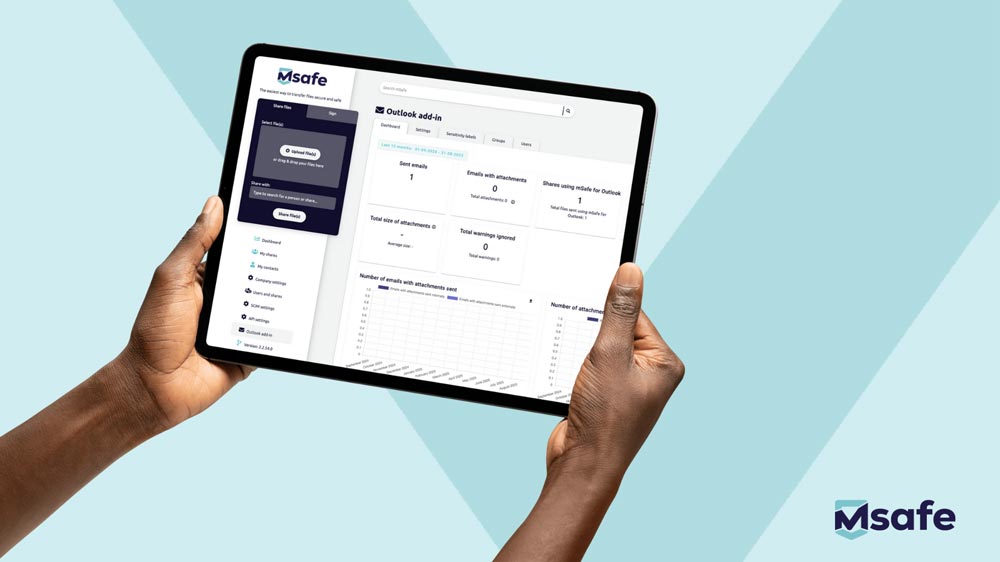
- mSafe installs as an Outlook add-in, allowing users to send files directly from their familiar e-mail environment.
- Unlike traditional solutions such as FTP servers or separate file-sharing platforms, mSafe requires no additional user management or infrastructure changes.
- Implementation is plug-and-play, with no complex configurations or integrations with existing IT systems.
2. End-to-End Encryption and Secure File Transfer.
- Files are encrypted client-side before they are uploaded and sent, preventing data from being intercepted in transit.
- The recipient must go through an authentication process to gain access, which provides additional protection against unauthorized access.
3. Support for large files (up to 100 GB)
- Using a scalable SaaS infrastructure, mSafe can handle files far beyond the limits of Microsoft Exchange.
- This is especially relevant for industries such as financial services, healthcare and legal firms, where large data sets need to be shared securely.
4. Auditability and Compliance
- mSafe provides a detailed audit trail of every file transfer, including metadata such as who sent the file, when it was opened, and whether it was downloaded.
- This ensures that organizations can easily comply with NIS2, GDPR and other regulations without manual log management.
5. Low total cost of ownership (TCO) through easy implementation
- Because mSafe operates as a SaaS solution, there is no need for additional hardware, infrastructure or maintenance.
- The Outlook add-in is readily available through the Microsoft Marketplace, so implementation takes only minutes.
- The user-friendly interface reduces the need for training, which accelerates adoption within organizations.
- Since mSafe operates independently of the email server, the IT department remains unburdened and there are no additional costs for server management or updates.
6. High availability and reliability
- mSafe runs independently of the Microsoft email server and offers 99.7% uptime, so files can always be sent securely, even during temporary email outages.
Microsoft 365 and mSafe a solid solution
The collaboration between Microsoft 365 and mSafe provides a technically robust solution for organizations struggling with secure and compliant file transfers. Where Microsoft 365 offers strong email encryption and compliance tools, mSafe fills in the missing link: the secure transfer of large files without infringing on the existing IT landscape.
With its simple plug-and-play deployment, minimal management burden and low TCO, mSafe is not only a secure, but also a cost-effective solution for companies looking to strengthen their data security without additional operational complexity.
With this integration, organizations get an end-to-end secure workflow without compromising on compliance, reliability or ease of use.